Two websites may give very different numbers because they are pricing different scopes. One quote may include hauling, disposal, slab removal, and rough grading. Another may cover only the mechanical teardown and leave the owner responsible for everything afterward.
Dallas service guide
How Much Does Demolition Cost in Dallas, TX?
Most people searching for demolition cost in Dallas want one number. Unfortunately, demolition does not price like a standard retail service. The final amount depends on the structure, access, foundation, debris, utilities, permits, and the condition you want the property left in.
DALLAS SERVICE GUIDEScope planning
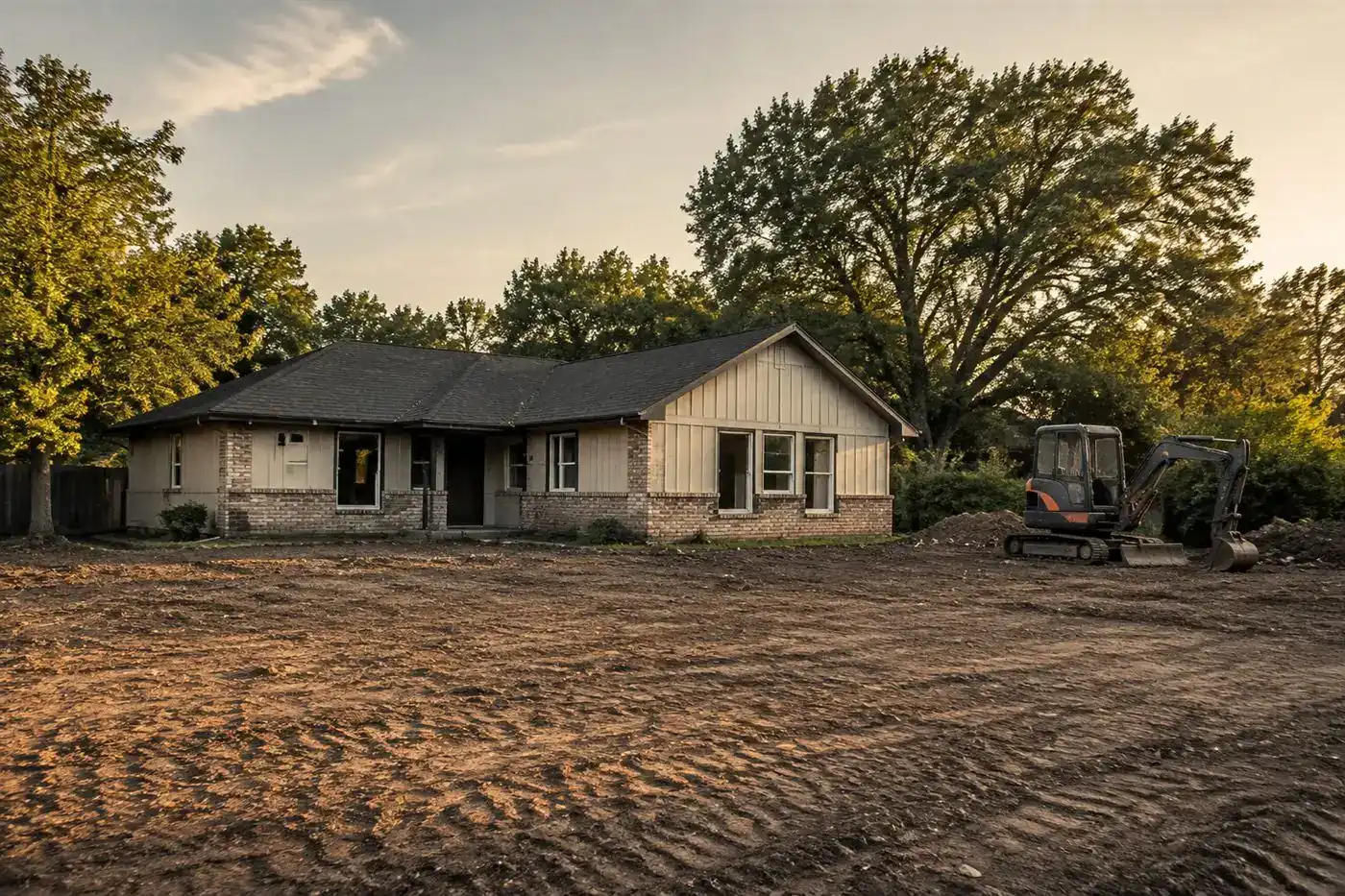 Define the handoffScope · access · next phase
Review the scope
Dallas demolition cost at a glance
As a general planning benchmark, published Dallas-area sources commonly describe costs in these broad terms:
01
A small or simple residential teardown may fall near the lower end of the market range.
02
A typical single-family house with straightforward access may land in the middle range.
03
Large homes, masonry structures, difficult lots, basements, heavy foundations, or hazardous-material concerns can move substantially higher.
04
Concrete driveway, slab, and foundation removal is often priced separately or treated as a major cost component.
05
Commercial and multi-structure work requires a project-specific estimate and may involve additional engineering, environmental, traffic, and disposal planning.
These ranges are compiled from local contractor pages and secondary cost reports, including ProMatcher’s Dallas demolition report, local DFW pricing examples, and Dallas house-demolition cost guidance. They are useful comparison points, not independently audited market averages.
The decision point
Why online demolition prices vary so much
A cost range may also be based on:
Before comparing numbers, ask what each number includes. A lower headline price is not necessarily a lower project cost if it leaves major work out of the contract.
A wood-frame house rather than a brick or masonry structure
A slab-on-grade property rather than a basement or pier-and-beam home
Easy access for a track excavator and dump trucks
No hazardous-material abatement
No unusual utility or right-of-way work
A short haul to an accepted disposal or recycling facility
A lot that does not need extensive backfill or finish grading
Review the scope
The main cost factors for a Dallas house demolition
Size and construction: Square footage matters, but it is only a starting point. A small brick house can require more breaking and hauling than a larger lightweight wood-frame structure. Multiple stories, thick masonry walls, chimneys, additions, attached garages, and heavy framing all change the equipment and labor plan. The type of materials also affects disposal. Wood, drywall, roofing, brick, concrete, metal, insulation, and mixed debris may be handled differently. If materials can be separated for recycling or salvage, that may affect the disposal plan, but the contractor should explain how any savings or credits are calculated. Foundation, slab, and driveway work: A house can be demolished while leaving a slab or foundation in place, or the contract can include full removal. Those are different scopes. Ask specifically whether the estimate includes:
01
Concrete slab breaking and removal
02
Footings and foundation walls
03
Basement excavation and backfill
04
Crawlspace or pier removal
05
Driveway and sidewalk removal
06
Porch, patio, retaining wall, or detached garage removal
Concrete is heavy. Removing it can increase loading, trucking, disposal, and equipment time. If your goal is a build-ready lot, ask what backfill, compaction, and grading are included after the concrete is removed. Site access and neighboring property: A demolition crew needs a safe route for equipment and trucks. Narrow driveways, fences, mature trees, overhead lines, retaining walls, soft ground, busy streets, and closely spaced homes can all affect the work plan. Dallas-area contractors also encounter different ground and drainage conditions. Blackland clay, limestone, uneven grades, and wet or restricted access can change how equipment moves and how the lot is restored. A site visit is much more informative than estimating from square footage alone. Utilities and preparation: Utility coordination can add cost and time if services are not ready for demolition. The owner and contractor should clarify responsibility for electric, gas, water, sewer, communications, irrigation, and private lines. If the project involves slab removal, foundation removal, excavation, or other ground-breaking, Texas811 should be part of the safety plan. Texas811 explains that a locate request should generally be made at least two working days before digging, excluding holidays. Public utility marks may not cover private lines on the property, so a separate private locate may be needed. Permits and local review: Dallas demolition work may require a city demolition permit and a final inspection. Additional review can apply in historic areas, conservation districts, demolition-delay overlay districts, floodplains, or other special locations. The current City of Dallas demolition checklist and DallasNow permitting information should be checked before using any online fee estimate. Permit amounts, forms, and requirements can change. A property within a Dallas Demolition Delay Overlay District may also face an additional review process. The city explains that qualifying buildings can be subject to a 45-day delay before a demolition permit is granted. That may affect the project schedule even if the mechanical demolition itself is straightforward. Asbestos and hazardous materials: Older buildings can contain asbestos-containing materials or other materials requiring special handling. Whether federal asbestos rules apply depends on the type of building and project circumstances. Commercial, institutional, industrial, municipal, and large-scale residential work can be treated differently from an isolated small residential teardown. The EPA’s demolition guidance recommends appropriate inspection and compliance planning where applicable. Do not assume a web calculator includes testing, abatement, special packaging, or regulated disposal. Ask how suspected materials are handled before demolition begins.
The decision point
What a complete estimate should show
A useful proposal should separate the major cost categories instead of presenting one unexplained total. Look for line items such as:
Not every project needs every line item. The point is to see what is included and what is not.
A proposal should also state the expected final condition. “Clean lot” can mean different things to different people. Ask whether the contractor will leave the site swept, raked, rough graded, compacted, seeded, or ready for a foundation.
Mobilization and equipment
Labor and site supervision
Structure demolition
Concrete, slab, or foundation removal
Utility preparation or coordination
Permit and inspection allowances
Asbestos inspection or abatement, if applicable
Loading and hauling
Disposal, recycling, or landfill charges
Final cleanup
Backfill and grading
Taxes, allowances, and change-order terms
The decision point
How to compare Dallas demolition estimates
Request at least two or three written proposals using the same project description. Give each contractor the property address, approximate size, structure type, photos, access information, known utility conditions, and your desired final lot condition.
Then compare:
Be cautious with estimates that pressure you to sign immediately or use a very low price without explaining the scope. A responsible contractor should be able to explain the major assumptions behind the number.
Included and excluded work
Slab and foundation assumptions
Hauling and disposal limits
Permit responsibility
Hazardous-material allowances
Schedule and weather assumptions
Change-order rules
Insurance documentation
Cleanup and grading standards
The decision point
Use a calculator for planning, not final bidding
A demolition calculator can help you organize the information that affects a budget: square footage, stories, construction type, foundation, access, concrete, debris, and disposal. It can also help you identify questions to ask before requesting a quote.
It cannot see concealed conditions, confirm utilities, assess hazardous materials, verify local review requirements, or inspect the soil. Treat the output as a planning range. The final price should come from a site-specific written proposal.
The decision point
Dallas demolition cost: the practical answer
For early planning, published Dallas-area sources suggest that many residential demolitions fall somewhere between the high four figures and the mid-five figures, with complexity driving the result. A simple house with easy access and limited site work may be much less expensive than a masonry home with a basement, difficult hauling, slab removal, historic review, or hazardous-material work.
The number that matters is not the cheapest advertised range. It is the complete price for the scope you actually need.
Before hiring, review the Dallas house demolition guide and Dallas demolition permit guide. Then request a written estimate that explains demolition, hauling, disposal, cleanup, and the final condition of the lot.
Local context
What is specific
to this place?
LOCAL CONTEXT
Local context — Dallas, Texas This demolition cost page is localized to Dallas. The relevant local variables are the exact municipality, property conditions, public right-of-way involvement, utility ownership, nearby structures, trees, drainage, floodplain status, environmental conditions, inspection sequence, and disposal rules. The page’s demolition cost Dallas TX guidance must be checked against current requirements for the address; surrounding DFW municipalities may use different processes.
Confirm current requirements for the specific property before work begins.Scope clarity
Know what the estimate is actually saying.
Use these boundaries to compare proposals on the same basis and confirm the final handoff.
What the working scope covers
- A demolition estimate may include mobilization, site protection, dismantling or removal of the described structure, loading, hauling, recycling or disposal, and cleanup when those items are identified in the written proposal. Depending on the project, it may also include slab, foundation, driveway, pool, accessory-structure, or rough-grading work. The estimate should show the quantities, unit or allowance basis, access assumptions, disposal plan, and final condition used to calculate the price.
What needs its own line item
- A planning price may exclude hazardous-material inspection or abatement, utility disconnection, private utility locating, engineering, permit or inspection fees, right-of-way work, traffic control, concealed foundations or buried debris, contaminated soil, unusual disposal, specialty shoring, imported fill, testing, backfill, compaction, drainage, grading, paving, landscaping, restoration, and new construction unless those items are separately listed. Allowances and change-order work should be identified instead of hidden in a single total.
Conditions behind the plan
- A useful estimate depends on the exact property and jurisdiction, structure or material being removed, dimensions and thickness, access, utilities, neighboring conditions, hazardous-material status, debris quantity, haul distance, disposal route, permit requirements, schedule, and desired final condition. Calculator results are planning ranges, not bids. A removal-only price, a clean-lot price, and a construction-ready handoff are different scopes.
Reference desk
Sources behind this guide.
Official references and project-specific starting points used to frame the page.
- 01
ProMatcher’s Dallas demolition report — https://demolition.promatcher.com/cost/dallas-tx-demolition-costs-prices.aspx
- 02
local DFW pricing examples — https://dallasdemolitiongroup.com/demolition-cost
- 03
Dallas house-demolition cost guidance — https://jrpdemolitiondallas.com/house-demolition-cost-dallas/
- 04
City of Dallas demolition checklist — https://dallascityhall.com/departments/sustainabledevelopment/Pages/formsdept.aspx
- 05
DallasNow permitting information — https://dallascityhall.com/departments/sustainabledevelopment/Pages/DallasNow.aspx
- 06
EPA’s demolition guidance — https://www.epa.gov/large-scale-residential-demolition/asbestos-containing-materials-acm-and-demolition
Next step
Ready to describe
the site?
Send the address, photos, access notes, project limits, and what should happen after the work is complete.
Use the Dallas demolition cost estimator or request a written scope-based estimate
Planning guidance is not a binding quote. Complex conditions receive human review.
Open project intake →